Blog
June 12, 2026
Rethinking Battery Performance: Why Rated Capacity Doesn’t Predict Runtime

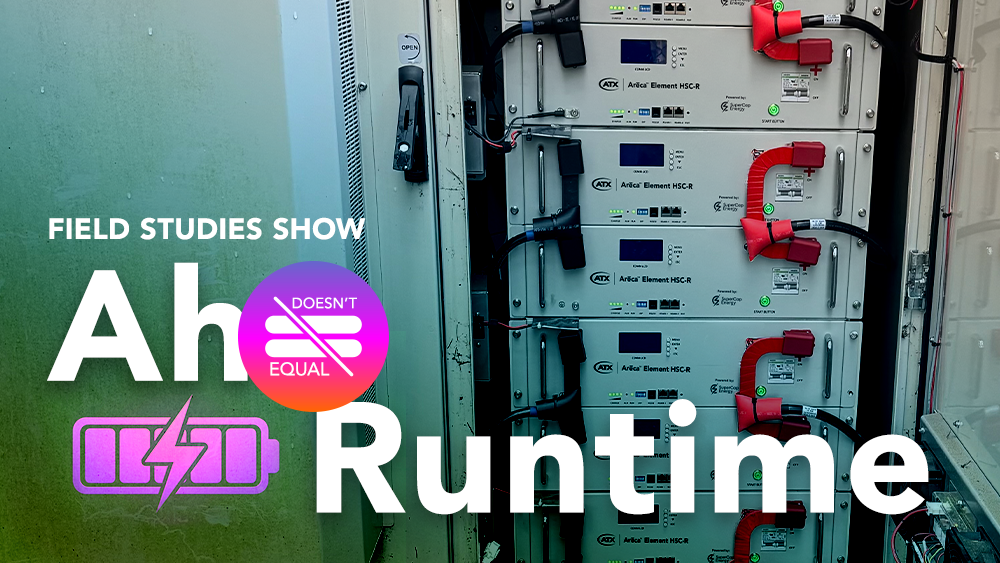
Your phone’s 18-hour battery life assumes low screen brightness and minimal app activity. Your WiFi’s advertised gigabit speeds assume you’re sitting next to the router. Every rated number comes with assumptions. Backup power is no different. Battery selection in telecom and critical infrastructure often starts with amp-hour (Ah) ratings. The assumption is simple: a higher Ah rating should deliver longer backup runtime. It is a useful baseline for comparison, and under controlled test conditions, that logic often holds. In the field, it often does not.
A recent Tier 1 provider deployment illustrates the difference. The existing VRLA battery system was rated at 190Ah and had been sized using conventional battery specifications, including typical load profiles, rack constraints and environmental conditions. Under live operating conditions, that system consistently fell short of its expected runtime targets.
Despite a lower
Ah rating, backup
runtime increased
by 220%
under live operating conditions.
After the site transitioned to a 150Ah, 48V 7.68 kWh Areca™ Element HSC-R Hybrid Supercapacitor system in the same environment, backup runtime increased to 8 hours under live operating conditions. That represented a 220% increase in delivered runtime, despite the lower Ah rating.
That’s not luck. That’s hybrid supercapacitor technology working as designed.
Hybrid supercapacitors are engineered to maintain stable output across thermal stress, variable loads and long-term cycling. This deployment reflected that design intent under real operating conditions. The comparison also points to a larger issue for anyone planning critical infrastructure: rated capacity does not equal usable runtime in production.
Why Lab Ratings Break Down in the Field
Amp-hour and kWh ratings are based on standardized test conditions, including stable discharge rates, controlled ambient temperatures, ideal depth of discharge and minimal aging. Those assumptions create a consistent baseline, but they do not reflect how deployed systems actually operate. In other words, conditions that rarely exist outside a lab.
In real telecom and edge environments, runtime depends on multiple variables working together. Elevated temperatures can reduce effective capacity and accelerate degradation. Uneven heat inside enclosures can create cell-level variability. Dynamic loads, transient spikes and fluctuating demand can reduce discharge efficiency or trigger protective limits earlier than expected. That is one reason a traditional VRLA battery can look sufficient on a datasheet but deliver less runtime once it is supporting an actual network load.
C-rate adds another layer. A fully charged 100Ah battery discharged at 1C provides 100 amps for one hour. At 3C, it provides 300 amps for 20 minutes. At 0.5C, it provides 50 amps for two hours. C-rate measures how fast a battery can charge or discharge relative to its total capacity, and it directly affects how much of that capacity is actually usable.
Higher C-rates generate more heat rather than usable power, reducing actual capacity on a nonlinear scale. In practice, that means a battery may meet its Ah rating under one discharge profile but deliver less usable energy when the actual load demands faster discharge or experiences repeated spikes. Higher C-rates can also accelerate long-term capacity fade and, in more severe cases, create safety hazards including swelling, leaks or fire risk.
Depth of discharge adds another constraint. Although a battery may carry a full-discharge rating, real deployments often limit usable depth to preserve lifecycle performance or comply with battery management system constraints. Over time, degradation compounds the issue. Heat, cycling and discharge depth can interact, causing usable capacity to decline faster than a simple rating comparison would suggest.
Together, these factors mean runtime is not simply a function of stored energy. It is a function of how consistently the system performs under actual operating conditions. Closing the gap between specification-sheet expectations and field performance is where system architecture, chemistry and power electronics become just as important as nameplate capacity.
Runtime Is the Metric That Matters
Many deployments still compensate for the gap between rated and actual performance by oversizing systems, applying conservative runtime assumptions or replacing batteries earlier than planned. For many applications, those strategies are entirely appropriate. Every battery chemistry has its strengths, and the right choice depends on the specific demands of the deployment. The question is whether those demands require a different kind of performance entirely.
The field result shows that two systems with different Ah ratings can deliver very different outcomes depending on how well they sustain performance under thermal stress, variable loads and long-term degradation. Hybrid supercapacitor technology is purpose-built for those conditions. The 220% runtime increase does not reflect a surprise result or a failure of lead-acid chemistry. It reflects a better match between the technology and the demands of the application.
Operators do not evaluate success by amp-hours alone. They care about how long a system lasts under real conditions, how predictable that runtime is and how performance holds up over time.
That makes delivered runtime under expected operating conditions a more meaningful metric than rated capacity alone. Evaluating systems by usable energy, temperature consistency, transient load response and degradation-adjusted lifecycle performance gives a clearer picture of how they will perform in production.
Side-by-Side Comparison: Valve Regulated Lead Acid vs. Areca Element HSC-R
This table compares a traditional Valve Regulated Lead Acid (VRLA) battery against the Areca Element HSC-R across the performance dimensions that determine real-world runtime. Both technologies serve different applications. For critical infrastructure where runtime consistency is essential, the difference is significant.
| Specification | Lead-Acid Battery (Representative VRLA) |
Areca Element HSC-R (48V 7.68 kWh) |
|---|---|---|
| EXAMPLE MODEL | PowerSafe SBS 190F | SCE48V7680EM-RM23 |
| RATED VOLTAGE | 12V | 48V |
| RATED CAPACITY (Ah) | 190 Ah | 150 Ah |
| ENERGY STORAGE (kWh) | ~2.28 kWh (per unit) |
7.68 kWh |
| ROUND-TRIP EFFICIENCY | ~70-80% | 97% |
| MAX DEPTH OF DISCHARGE | ~50% (practical) |
100% |
| CYCLE LIFE (25°C) | ~500-1,000 cycles | 20,000 cycles |
| DISCHARGE TEMP. RANGE | -40°C to +50°C (derated at extremes) |
-10°C to +60°C (stable output) |
| SELF-DISCHARGE RATE | ~3-5% per month | 2% per month |
| THERMAL RUNAWAY RISK | Yes (at elevated temps or overcharge) |
None |
| MAX CONTINUOUS CURRENT | ~133 A (15-min rate) |
100 A continuous |
| MONITORING | Basic (external BMS required) |
Integrated (voltage, current, temp, SOC, SOH, cell voltage) |
| COMPLIANCE/SAFETY | ISO 9001, UL94-V0, SR-4228 | UL1973, UL810A, UL9540A, UN38.3, RoHS |
Note: Lead acid battery figures are representative values for a 12V front-terminal VRLA unit operating in telecom standby service. Actual performance varies by installation, load profile and ambient conditions.
The Bottom Line
Amp-hour ratings still serve as a useful baseline, but they do not tell the full story. For teams planning or evaluating backup power infrastructure, the more useful question is how a system performs under real operating conditions, not ideal ones.
Battery performance is not defined by what a system can deliver on a spec sheet. Like every rated number, it comes with assumptions. What matters is what it consistently delivers when the network needs it most.

